
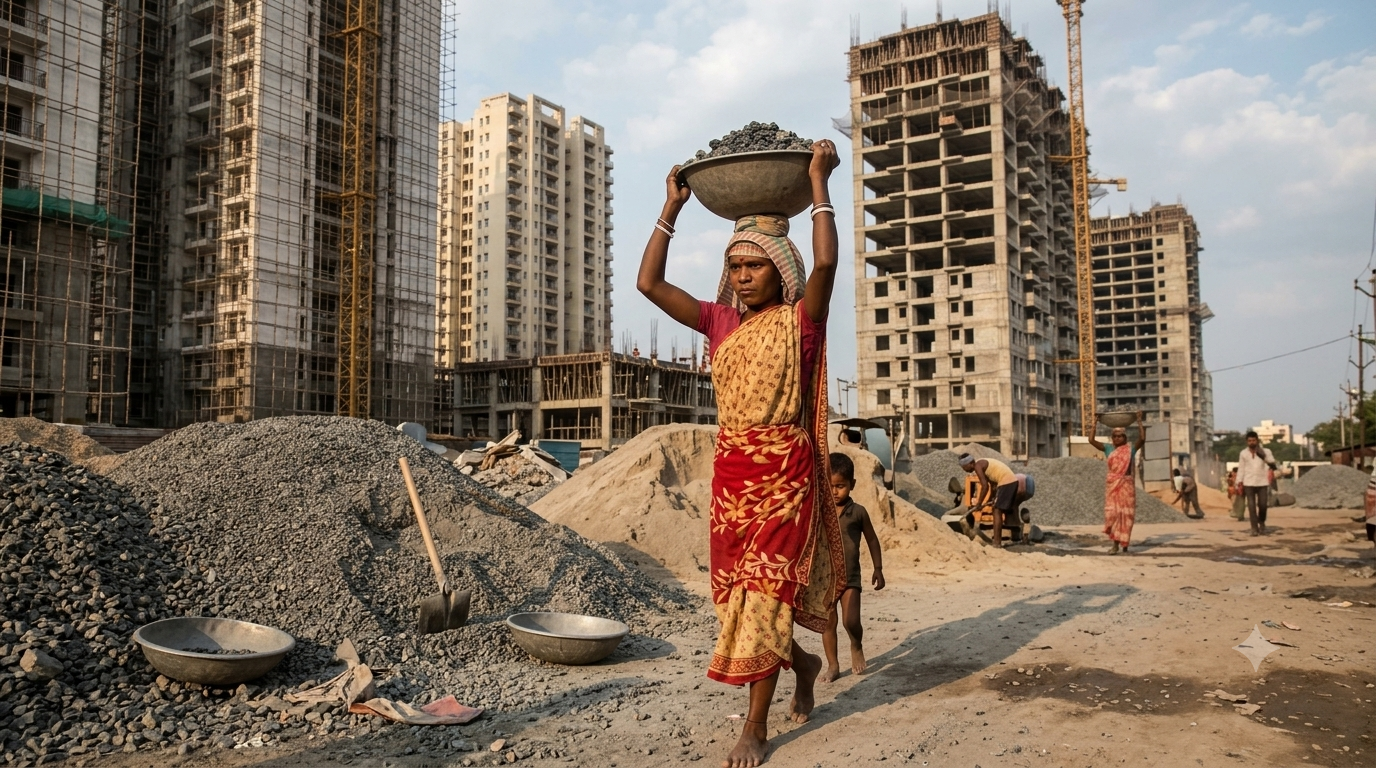
When we look at a new building, road, metro station or any growing city, we usually notice the structure. We admire the design, height and other related things. But how often do we think about the people who actually built it? During one of my field visits to a construction site in Ghaziabad, I met a group of women who were working as labourers. What I saw that day stayed with me.
The women were carrying bricks, mixing concrete and carrying material from one place to another. These were physically demanding tasks, yet they did them as a normal part of their workday. They had arrived at the site around 7 in the morning and left around 5.30 in the evening. Their work hours were long and physically tiring. But the physical work was not the only thing that caught my attention. What stayed with me was the gap between the contributions these women were making and the basic facilities available to them.
The Double Burden
During their 30-minute break, I noticed that two of the women had small children with them. Instead of resting during the break, they were also taking care of their children and feeding them. This small moment made me think about the double burden carried by many women workers. For those women, work does not end when they leave the construction site. Their responsibilities also include caring for children, managing the household and family needs. At the construction site, they are workers; at home, they are often caregivers. This combination of paid and unpaid work is rarely visible when we talk about economic development.
We often discuss how cities are growing and how infrastructure is improving. But we do not ask who is carrying the physical and emotional cost of this development.
Dignity at the Workplace
What disturbed me the most during my visit to the construction site was the lack of toilet facilities for the workers. There was no basic toilet facility for the women workers. I asked them how they managed during their menstrual periods. They did not give me any reply; they simply smiled. That smile said more than words could. It was not a smile of happiness. It felt like a smile of discomfort, acceptance and perhaps the feeling that this was something they had become used to.
“Yaha par shouchalay hona chahie… hame bohot dikkato ka samna karna padta hai.”
That moment made me realise that sometimes the most basic needs of workers are treated as just optional. But a toilet is not a luxury. For women workers, access to a safe and usable toilet is closely connected with dignity, health and the ability to work with comfort and safety. Research by the ILO also highlights poor sanitation conditions as a significant concern for women workers at small construction sites in India.
The Wage Gap
I also spoke with the women about their wages. Their response was simple.
“Itni mehnat karne ke baad bhi hame yaha kaam karne wale admiyo se kam he pagaar milti hai.”
This was another moment that stayed with me. The women were doing physically demanding work. They were carrying bricks, mixing concrete and transporting materials. Yet they told me that their wages were lower than those of men. The issue of unequal wages is not only about money. It is also about how women's labour is valued. When the same or equally demanding work is valued differently because it is performed by women, it sends a powerful message about whose labour matters.
The ILO has documented continuing gender wage inequality. A 2025 International Labour Organisation (ILO) report on the Indian construction industry noted that women remain concentrated in lower-paid positions and face systemic barriers to advancement.
Migrant Women Workers
Most of the women I met at the site had come from different states. Many of these women are migrant workers who have moved away from their home regions in search of employment. Migration often means leaving behind familiar surroundings, family networks and community support. For women, the challenges can be even more complex. They have to earn a living while also managing childcare, household responsibilities and the difficulties of living and working away from home. Yet migrant women workers are often seen simply as labourers available for work. Their individual stories, skills, aspirations and challenges remain largely invisible. This made me think about the meaning of development.
Can we really call a city inclusive when the people who physically build it do not have access to basic dignity at their workplace?
Rights on Paper vs Rights in Practice
India has laws, policies and programmes that recognise equality and workers' rights. On paper, women and men have equal rights. But my field experience made me think about the distance between rights on paper and rights in practice.
A woman may have the right to equality, but if she receives less pay for her work, how equal is her economic position? A woman may have the right to dignity, but if there is no toilet at her workplace, how is that dignity protected? A woman may be part of the workplace, but if her work is seen only as low-paid manual labour, are her skills and contribution truly recognised?
These questions cannot be answered through policies alone. They require implementation, monitoring and a change in how we value women's work.
The Way Forward
Construction sites should be designed with women workers in mind. Basic facilities such as clean toilets, drinking water, safe working conditions and appropriate rest spaces should not be considered additional benefits. They should be treated as essential workplace requirements.
Women workers should also receive equal pay for equal work. Their skills should be recognised, and they should have access to skill development and better employment opportunities. For women with young children, childcare facilities can make a significant difference. Migrant workers also need easier access to social protection and welfare services, especially when they move across states.
The Government of India has been working through the Building and Other Construction Workers (BoCW) welfare systems to extend social security and welfare support to construction workers, but effective implementation and access at the ground level remain important.
A Lasting Thought
That visit to the construction site in Ghaziabad changed the way I look at a growing city. Since then, whenever I see a newly constructed building or road, I think about the hands that made it possible. I think about the women carrying bricks. I think about the women mixing concrete. I think about the mother feeding her child during a short break. And I remember the smile I received when I asked about toilets during menstruation.
That smile has stayed with me because it reminded me that inequality is not always visible in numbers. Sometimes, it is visible in the things people have learned to live without.
Women construction workers are not just “labourers”. They are workers who contribute directly to our cities and our economy. If we want truly inclusive development, we must ensure that the women who help build our cities are themselves able to work with dignity, safety, equality and respect.
A city should not only be judged by the buildings it creates. It should also be judged by how it treats the people who build them.